

Conditions affecting the retina and vitreous humour
Our retina ophthalmologist specialises in treating diseases of the retina.
Floaters
What are floaters?
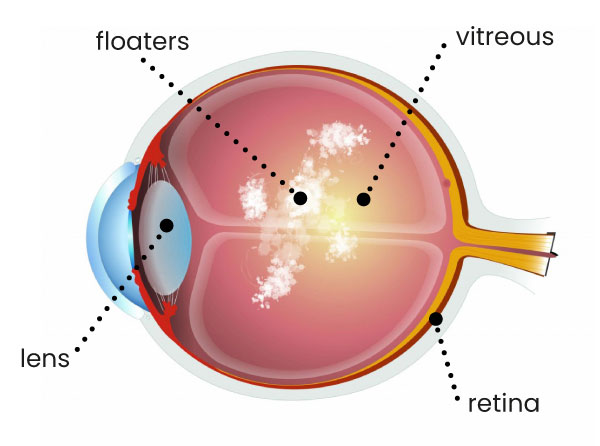
If you see black, floating spots, dots or lines in your field of vision, especially against a light background like a computer screen or bright light, that may mean you have ‘floaters’.
These spots move slowly with the movement of your eyes and always look like they are returning to their starting position. They can occur in one eye or both eyes. Floaters are structures that move around in the vitreous, the gel that fills your eyes. Although these are mostly harmless and just a bit annoying, floaters are sometimes a symptom of another condition. Follow-up by your eye doctor is therefore required.
Age-related macular degeneration (AMD)
What is age-related macular degeneration?
Age-related macular degeneration (AMD) is a condition of the central part of the retina. This part of the retina, the macula, is responsible for seeing small details. Age-related macular degeneration is often referred to as the ‘wearing’ of the retina or ageing of the retina. AMD affects visual acuity. This can be due to such factors as an hereditary condition, age or environmental factors.

Diabetic retinopathy
What is retinopathy?
If you have diabetes, the blood vessels in the retina may be affected. This is known as diabetic retinopathy. This form of damage to the retina due to leaking or abnormal blood vessels can lead to a deterioration of vision or even blindness. Regular check-ups by your eye doctor are therefore very important.
Vitrectomy
What is vitrectomy?
Vitrectomy is an operation on the vitreous and/or retina. You may need this type of operation if you suffer from a condition of the retina or vitreous, such as in the case of floaters, diabetic retinopathy or a detached retina.
Frequently Asked Questions
What are floaters in the eyes and what causes vitreous opacities?
Floaters are small black spots, dots, or thread-like shapes drifting in your field of vision, especially noticeable against a bright background such as a computer screen. They are caused by aging changes in the vitreous gel inside the eye. From the age of 50–60, the composition of the vitreous changes, making opacities and protein deposits visible. Nearsighted people are more prone to developing floaters.
Do floaters ever go away and what can you do about them?
Floaters usually become less bothersome over time, but they rarely disappear completely on their own. At Medipolis Eye Center, floaters can be treated with vitreolysis, a completely painless laser treatment that dissolves the floaters into tiny gas bubbles. A session lasts 20 to 40 minutes, and two to three treatments are usually needed.
What is macular degeneration and what is the difference between dry and wet macular degeneration?
Age-related macular degeneration is wear and tear of the macula, the part of the retina responsible for sharp central vision. Symptoms include blurred vision, a dark or blurry spot in the center of vision, and image distortion. In dry macular degeneration, deposits called drusen slowly build up. In wet macular degeneration, leaking blood vessels develop beneath the macula, causing vision to deteriorate more rapidly.
What new treatments are available for macular degeneration?
For wet macular degeneration, injections with anti-VEGF medication are the main treatment. Patients usually receive three monthly starter injections, followed by four to six injections per year. These injections can often stop further deterioration. Dry macular degeneration can be slowed somewhat with vitamins and nutritional supplements.
What is diabetic retinopathy and how is it treated?
Diabetic retinopathy is damage to the retina caused by leaking blood vessels as a result of diabetes. Symptoms include reduced or blurred vision, spots in the field of vision, and distorted vision. At Medipolis, the leaking blood vessels can be treated with laser therapy. The treatment slows the progression of the disease but does not completely cure the retinopathy.